
· Rachel Bennett
What Size Meditation Cushion Should I Get?
Size is the question people ask last, and it is the one that decides whether a seat works. Fill, fabric and color are preferences; height is mechanics. It sets where your pelvis sits relative to your knees, and that relationship is what holds a spine upright without effort. Get it wrong by two inches and you spend every session negotiating with your lower back.
I have kept a daily sit going for twelve years and measured dozens of seats with a tape in my own studio. This guide is about measuring, not shopping.
The two numbers that decide the size
A meditation cushion has two dimensions worth arguing about. Seat height is how far your sit bones end up above the floor once the cushion has taken your weight; width, on a round cushion, is the diameter of the disc. They solve different problems and are not interchangeable.
Height governs the angle of your pelvis. Lift it and the pelvis tips slightly forward, the lumbar curve returns, and the spine stacks over the sit bones. Too little and the pelvis rolls back into a slump; too much and it tips past neutral, pushing the ribs forward and handing the work back to the lower back. Width governs contact: how much of your seat and upper thigh is supported, and whether your sit bones land well inside the edge.
| Dimension | Typical range | What it controls | Set by |
|---|---|---|---|
| Seat height | 2 to 6 in | Pelvic tilt, knee position, spinal stack | Your hip flexibility |
| Width (diameter) | 12 to 16 in | Contact area, stability, thigh support | Your build and leg fold |
Everything else on a spec sheet is comfort or upkeep.
How to measure your seat height at home
All you need is a firm blanket and five minutes on the floor, ideally in the morning when you are stiffest, because a seat that works stiff works all day.
Fold a wool or cotton blanket into a firm rectangle about an inch thick and sit on the front edge with your legs crossed. If your knees hang above your hip crease, refold to add half an inch and sit again. Repeat until both knees settle at or just below the crease and your lower back stops rounding on its own. Most people land between two and six inches, and the last half inch is obvious: it is the one where you stop bracing.
Now the step almost everyone skips. Measure the stack while you are still sitting on it, reading the compressed height rather than the loose one: a stack that stands three inches tall on the floor is often barely two under an adult. That compressed number is what you compare against a cushion's stated thickness, because a firm foam disc keeps its number and a soft stack does not.
of U.S. adults practiced meditation in 2022, making it the most used complementary health approach in the national survey
— NIH/NCCIH analysis of the National Health Interview Survey, published in JAMA, 2024
The wall test: a thirty-second cross-check
The blanket test gives you a number. The wall test tells you whether to believe it. Sit on your stack a few inches from a wall, legs crossed, settle without correcting anything, then lean back gently until your shoulder blades touch.
If they reach the wall while your lower back keeps its small natural arch, your height is right. If your tailbone slides forward and your lower back flattens against the wall before your shoulders arrive, the pelvis is tipping backward and you need more lift. If your ribs flare and the gap behind your waist is wide enough to post a letter through, you have gone past neutral. Take half an inch back.
What the test reads is hip rotation, not willpower. Crossing your legs asks the thigh bones to rotate outward in the sockets; when that rotation is limited, the knees stay high and the pelvis has nowhere to go but backward.
The wall tells you which way to move, not how far. Run it once at the height your blanket gave you, adjust by half an inch, and run it again the next morning. Which seat delivers that number, and which band of hip flexibility it corresponds to, is set out type by type in our best meditation cushion guide; this page stops at the measurement.
Seat height by sitting position
The same body needs different heights in different positions. The technique for each posture is in how to sit on a meditation cushion; what follows is only the height each one asks for.
| Position | Height that usually works | Why that number |
|---|---|---|
| Burmese (shins parallel, both flat) | Your measured number | Nothing is stacked, so the knees reach the floor with least lift |
| Easy pose (shins crossed) | Half an inch to an inch more | The crossed ankle raises one knee and asks for extra tilt |
| Seiza (kneeling, cushion between the heels) | Low and flat, whatever your hips | Height comes from your shins; the seat only unloads the ankles |
| Quarter or half lotus | An inch or more above it | A foot on the calf or thigh lifts a knee that must be met with height |
Seiza is the one that surprises people. Kneeling needs almost no hip rotation, so a tall seat is not merely unnecessary: it wedges the pelvis into a forward tip and loads the knees. A low disc laid flat between the heels does the whole job, however tight your hips are cross-legged, and the same logic governs the frames in meditation cushion vs bench.
Width: how much floor the seat has to cover
Round meditation cushions cluster between 12 and 16 inches across, and that range exists because bodies do. The rule: your sit bones should land well inside the edge, so a shift of weight does not put you on the rim. On a narrow disc under a broad frame, that rim becomes a pressure line across the back of the thighs within twenty minutes.
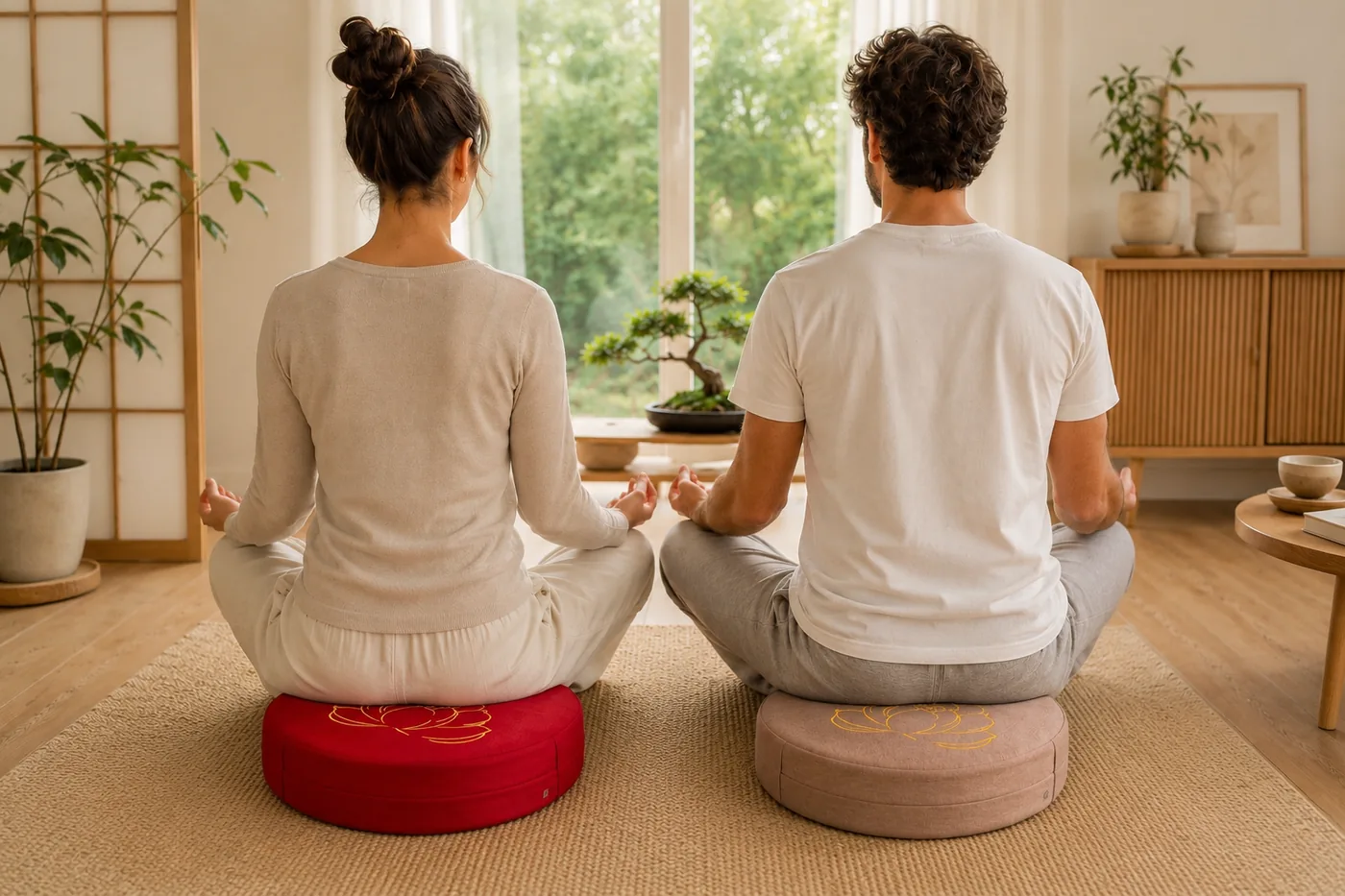
Two things push you toward the wide end. Broader hips need more surface for the sit bones to rest comfortably apart. And longer sessions reward width, because load spread over a wider patch takes longer to become a hot spot: at ten minutes a day a small disc is fine, at forty width buys you the back half of the session. What it costs is floor space rather than posture, and a wide seat doubles better as furniture, which is the argument of our floor pillows for sitting page.
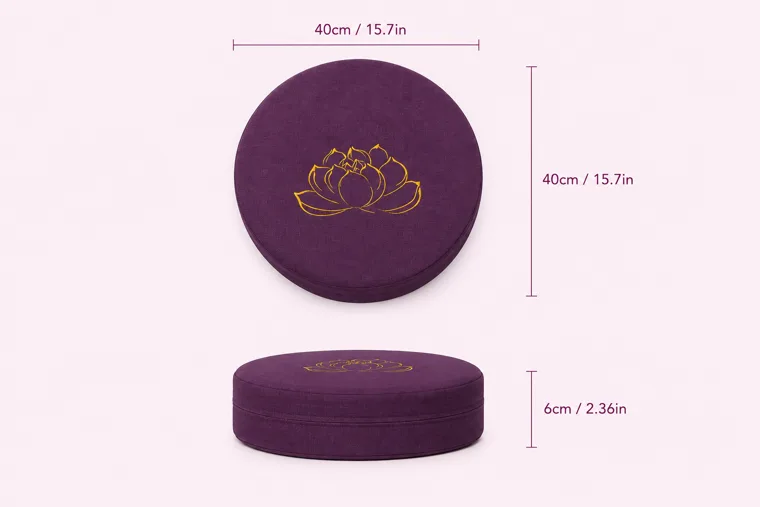
Hands-on data from our studio: the StillSeat meditation cushion measures 40 cm / 15.7 in across and 6 cm / 2.36 in thick with a tape, and the high-density foam core holds those numbers under a seated adult instead of spreading sideways. That is the wide end of the width range and the low end of the height range. A verified buyer put it in their own words on our reviews page: "A lot larger than expected but that's not a bad thing as my glutimus maximus isn't small."
Two people in a household rarely need different widths, but the per-seat price drops on the meditation cushion set multi-packs.
What a rug or a mat does to your height
Here is the variable nobody measures. Seat height counts from the surface your knees are on, not from the floorboards. Put a cushion on a thick rug and your knees sink into the padding while your sit bones stay up on the firm disc. The gap widens, and your effective height rises by whatever the padding compresses under a knee.
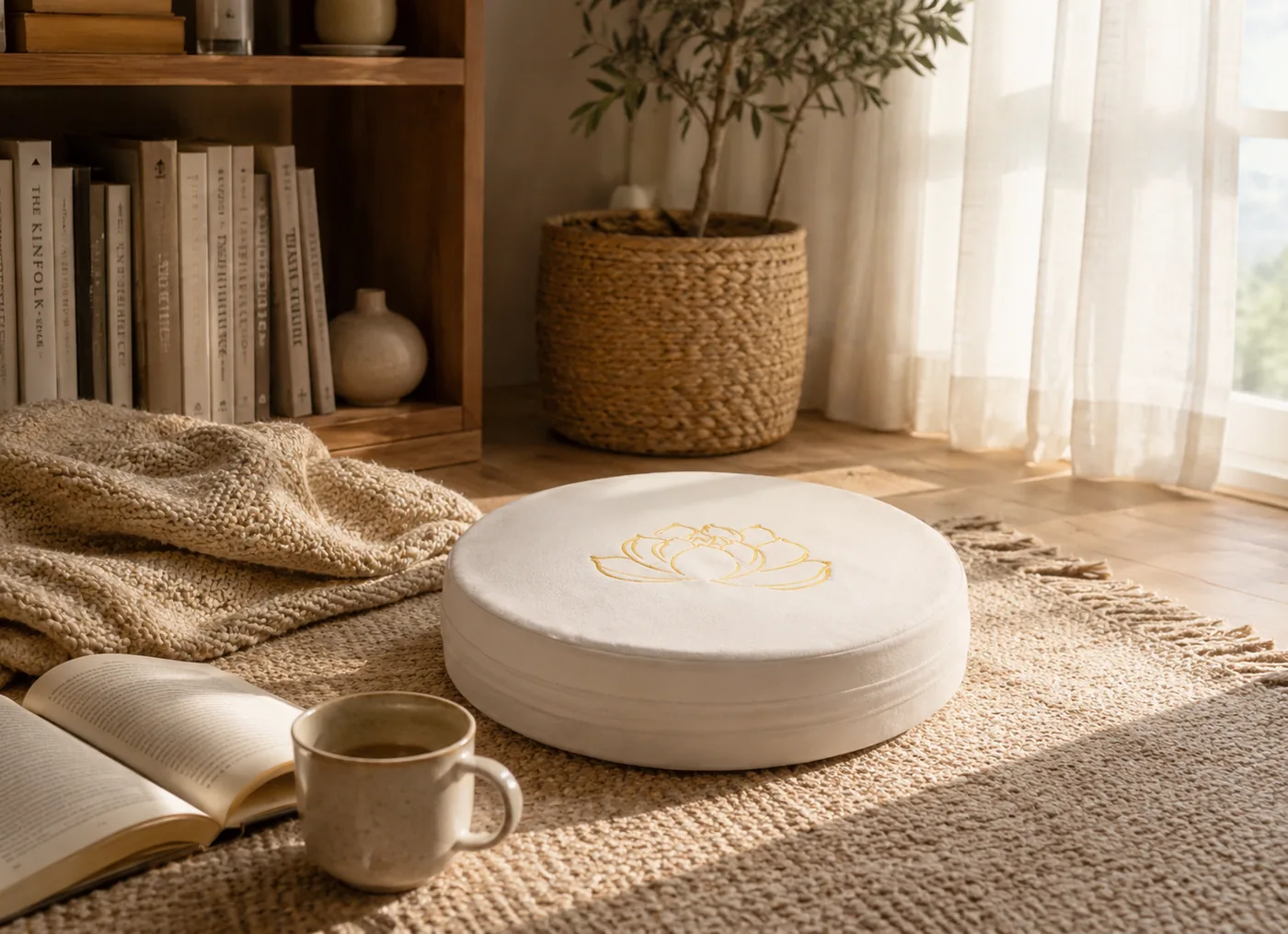
That can work for you or against you. If your knees float on bare wood, moving the setup onto a plush rug adds half an inch of tilt at no cost. If your seat already fits, the same rug tips you past neutral. Either way, run the blanket test on the surface you actually sit on, not on the kitchen tiles.
A traditional flat mat is a different case: firm enough to lift the knees and the seat by similar amounts, so the two mostly cancel out. We explain how the two pieces divide the work in zafu vs zabuton.
of U.S. adults practiced yoga in 2022, many of them sitting on a mat rather than a bare floor
— CDC NCHS Data Brief No. 501, 2024
Signs the size is wrong
A seat that is too low announces itself in the lower back. You start upright, and around minute eight the tailbone tucks, the ribs drop, and you catch yourself hauling your chest back up. That is the pelvis rolling backward for lack of lift.
A seat that is too tall complains higher and further forward: the lumbar curve deepens, the ribs push out ahead of the hips, and the front of the hip joints feels worked rather than open. Numb feet point instead to a narrow seat pressing the back of the thighs.
Ten minutes is where a mis-sized seat gives itself away. Notice the first moment you correct something, then change one dimension only, half an inch at a time. Changing two things at once teaches you nothing.
Every figure here came off a tape measure in our own studio. Once you have your two numbers, the best meditation cushion guide matches them to a type of seat.
Meditation cushion size FAQ
What size meditation cushion do most people need?
Two numbers, not one. Seat height runs from about 2 to 6 inches across the range of bodies, and width from 12 to 16 inches. Height is set by your hips and width by your build, so they are measured separately and neither one substitutes for the other.
How do I measure the seat height I need?
Build a blanket stack under you, adjust it half an inch at a time until your knees settle at or just below your hip crease, then measure the stack while you are still sitting on it. That compressed reading is your number. A stack that stands three inches loose is often barely two under an adult.
Does a bigger meditation cushion mean a better seat?
No: width and height do different jobs. Extra width gives your sit bones and thighs more surface to land on. Extra height past what your hips need tips the pelvis too far forward and puts the lower back to work again.
How wide is the StillSeat meditation cushion?
We measured it at 40 cm / 15.7 in across and 6 cm / 2.36 in thick with a tape in our studio: the wide end of the width range, the low end of the height range. That suits flexible hips and seiza.
Free shipping · 30-day 30-day returns