
· Rachel Bennett
Round vs Crescent Meditation Cushion: Which Shape Fits How You Sit
Shape is the spec most people read as decoration. Color, embroidery, outline: three things that look like taste. Two of them are. The outline is mechanics, because it decides where the material ends up under you, and material under your thighs behaves very differently from material behind your pelvis.
I have kept a daily sit going for twelve years. This guide is only about the outline: not the height, not the fill, not the fabric, but the shape seen from above and what it does once your legs are folded on it.
Two outlines, two different jobs
Draw both from above and the difference is one cut. A round cushion is a closed circle: every point on the edge sits the same distance from the center, and the material runs unbroken all the way round. A crescent is that same circle with a bite taken out of the front, leaving a thick back, two forward horns, and an open scoop between them.
That single cut changes three things at once. It gives the seat a front, so the cushion now has a correct way round. It removes material from under the middle of your crossed shins. And it concentrates what is left into the two horns, where the thighs land.
| Seen from above | Round disc | Crescent |
|---|---|---|
| Outline | Closed circle, uniform edge | Half-moon, front scooped out |
| Orientation | None: any direction is the front | One: horns point forward |
| Under the thighs | Continuous support out to the rim | Two horns, gap in the middle |
| Behind the pelvis | Full material, weight can settle back | Full material, thickest point |
Everything else people argue about — color, embroidery, cover weave — happens above that line and changes nothing about the seat.
The round disc: one rim, every direction
The useful property of a circle is that it has no orientation. Your sit bones land inside the rim, your weight spreads across the top, and if you turn ninety degrees to face a window you meet the same edge at the same height. Nothing to line up in a dim room at six in the morning.
That continuity is what lets one seat carry several postures. Cross your legs and the rim runs under both thighs; kneel over it and the same rim runs under both shins; put it beside a coffee table and it is a firm round seat, which is the argument our floor pillows for sitting page makes at length.
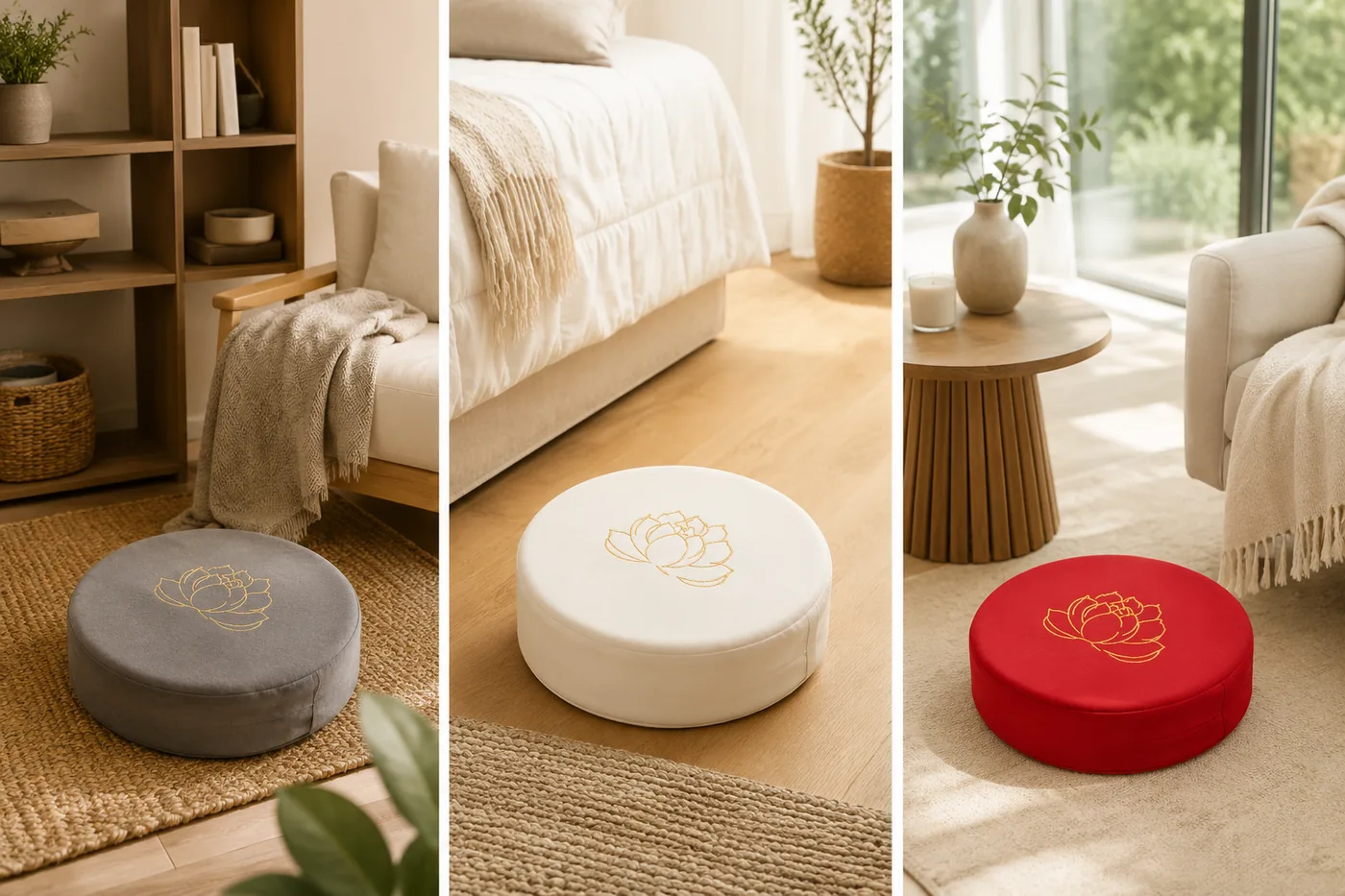
The rim has a second job you notice only after twenty minutes: it is the line where support stops. On a round seat that line runs behind the whole length of both thighs, so the load spreads along a curve rather than piling into two points. A wide disc pushes it further out, which is why width is a separate decision from shape.
The closed circle carries one more consequence, easy to miss: the material continues under the front of your thighs, so a round seat holds them at whatever height the disc is. On a low disc that is fractions of an inch, and it disappears the moment your knees reach the floor. On a tall one it becomes the thing a crescent was drawn to solve. The four seat types and their heights are laid out in our best meditation cushion guide.
The crescent: a front edge cut away
A crescent cushion is a half-moon that supports the thighs while leaving room behind the pelvis, and the shape is built for one specific effect: a pronounced forward tilt of the pelvis. The thick back sits under and behind your sit bones and rocks you forward. The two horns catch the outside of each thigh and carry part of their weight. The scooped front leaves the space where crossed shins would otherwise be pressing into cushion.
That geometry lets the thighs slope more steeply than a same-height disc allows, because nothing under their inner edge holds them up. Typical crescents run 3 to 5 inches at the seat, and with less material under you overall the height plays a little lower than the number suggests.
What the cut costs is range. The shape reads as a seat in one orientation and in one posture: a cross-legged position committed to a forward tilt. Turn it round and the horns dig in. Kneel on it and the scoop sits exactly where your weight needs to land. The crescent buys a steeper thigh slope and spends everything else on it.
Shape by the way you sit
Positions are where the two outlines separate cleanly. The technique for each is set out in how to sit on a meditation cushion; what follows is only what each posture asks of the shape underneath.
| Position | What the shape has to do | Which outline serves it |
|---|---|---|
| Easy pose (shins crossed) | Let both thighs slope down while one knee rides higher | Either — the crescent's scoop suits a steep tilt, the round rim suits a level, settled seat |
| Burmese (shins parallel, both flat) | Support both sides evenly with nothing stacked | Round — both shins clear the front edge and there is no orientation to manage |
| Seiza (kneeling, seat between the heels) | Carry weight in the middle and unload the ankles | Round, laid flat — the crescent removes material exactly where a kneeling seat needs it |
| Quarter or half lotus | Meet a knee that a foot on the calf or thigh has lifted | Round at the taller end of your range; a crescent only if the forward tilt is deliberate |

The pattern in that table is the practical answer. A crescent suits a practice that sits one way, always, with the pelvis driven forward. A round disc suits a cushion that has to cover a real fortnight: easy pose on Monday, a kneel on Thursday because your hips are tight, floor seating on Saturday because someone came over. Most home practices look like the second list.
of U.S. adults practiced meditation in 2022, making it the most used complementary health approach in the national survey
— NIH/NCCIH analysis of the National Health Interview Survey, published in JAMA, 2024
What each shape asks of your knees
Your knees report on the shape long before your back does. On a round seat the thighs cross the rim in a smooth arc, so contact is a line rather than a point. Pressure spreads along it, and the wider the disc, the further out that line falls and the later you notice it. On a narrow seat, with your sit bones close to the edge, the rim becomes a ridge across the back of the thighs instead.
On a crescent, contact is deliberately concentrated. The horns take the outer thigh on each side and the middle is left empty, which works while the tilt is doing its job and stops working if your legs fold tighter than the scoop was drawn for. Numb feet, or a warm patch under one thigh, are the same message: the material is meeting your leg in too small a place.
Ten minutes is long enough to read either. Sit, do nothing, and note the first moment you shift. Then change one variable — turn the seat, move back half an inch — and read it again. What you are testing is contact, and it is the part a photograph cannot show you. How a kneeling frame changes the same equation is covered in meditation cushion vs bench.
Where shape stops and height begins
Here is the line people blur most often. Shape does not set height. Two seats measured at the same compressed height give the same lift whatever their outline, and the lift is what brings your knees toward the floor. Choosing a crescent because you need more height is picking the wrong variable; choosing a round disc because you need less is the same mistake in reverse.
Height comes from your hips, width from your build, and both are readable on your own floor in five minutes with a folded blanket and a tape. That method lives in what size meditation cushion should I get, and it is the measurement to run before you think about outlines at all.
of U.S. adults practiced yoga in 2022, many of them sitting on a mat rather than a bare floor
— CDC NCHS Data Brief No. 501, 2024
Two other variables live outside this page. Fill decides whether the shape you chose is still the shape you sit on at minute forty: dense foam keeps its profile, loose hulls migrate and let a crescent's horns flatten. And what goes underneath — a flat mat under the knees, one seat stacked on another — has its own logic, which we work through in zafu vs zabuton rather than repeat here.
In numbers: the StillSeat meditation cushion is a round disc 40 cm / 15.7 in across and 6 cm / 2.36 in thick, with a flat top, a straight side wall and a high-density foam core. A verified buyer put the firmness in their own words on our reviews page: "They are hard, don't think they are soft. Perfect for posture."
Choosing the outline your practice uses
Choose from your own last fortnight rather than from a product photo. Write down how many times you sat and in which position. If every line reads the same — cross-legged, facing the same way, tilted forward on purpose — then you are the narrow case the crescent's scoop was drawn around.

If the list is mixed, the closed circle is doing more work than it looks like it is doing. It absorbs the day your hips are tight and you kneel instead, the evening you sit on it to read, and a second person in the house sitting down without being told which way round it goes. A shape with no front is a shape with nothing to get wrong.
That is the outline we sell: a low, wide, firm round disc in seven colors, with a linen cover that unzips for the wash, made for the mixed list. Run your height measurement first, then pick the shape that matches how your fortnight actually looked.
Round vs crescent cushion FAQ
Should I get a round or a crescent meditation cushion?
Count the ways you sit. A crescent is built around one orientation and one seat: a cross-legged position with a pronounced forward tilt. A round disc has no front, so the same seat serves easy pose, Burmese, kneeling and floor sitting without being turned.
Does a crescent cushion work for seiza?
It is not the shape for it. Kneeling asks the seat to carry your weight between your heels, and the crescent removes material at exactly that spot to make room for crossed shins. A low round disc laid flat covers the whole area instead.
Does the shape change the seat height I need?
No. Height is set by your hips, and two shapes at the same measured height give the same lift. Shape decides where the material sits under your thighs, not how far off the floor you end up. Measure the height separately.
What shape is the StillSeat meditation cushion?
A round disc with a flat top and a straight side wall, 40 cm / 15.7 in across and 6 cm / 2.36 in thick, with a high-density foam core inside.
Free shipping · 30-day 30-day returns