
· Rachel Bennett
Buckwheat vs Kapok Cushion Filling: How Each One Sits Under You
Shape and height are the specs a cushion listing puts in bold. Fill is printed underneath in small type, and it is the one your legs report on first: it decides how the seat takes your weight in the opening seconds, and whether the seat you sat down on is the same seat forty minutes later.
I have kept a daily sit going for twelve years. This guide covers the material inside, not the outline, which our round vs crescent guide handles.
Buckwheat hulls: a granular fill that moves with you
Buckwheat fill is the hard outer husk of the grain, cleaned and poured loose into the cushion: a material closer to dry rice than to stuffing. Each hull is a small rigid shell, and a cushion full of them behaves like any granular material. It flows while being loaded, then jams into place and stops.
That two-stage behavior is the appeal. Sit down and the hulls travel out from under your sit bones toward the rim, so the seat takes an impression of you rather than the other way round. A second later they have interlocked and the seat has gone rigid in that shape: a firm mold of your own underside.
Because the hulls are individually hard, the fill redistributes rather than compressing. Push a hand into a filled zafu and you feel material sliding sideways, not squashing flat, which is why a well-filled buckwheat seat can hold a real lift: our best meditation cushion guide puts the traditional zafu in the 4 to 6 inch band. The costs come from the same property. Loose grain is heavy and bulky, it does not stay level on its own, and moving hulls can telegraph through a thin cover as a lumpy layer.
Kapok: a fiber fill that springs back
Kapok is the seed fiber of the kapok tree, a fine silky floss that arrives as a loose mass rather than as separate pieces. Where hulls are grains, kapok is a batt: it traps a great deal of air between the fibers, and load squeezes that air out.
Sit on a kapok zafu and the seat gives, keeps giving for a moment, then pushes back with a springiness hulls do not have. Nothing shifts underneath you. The fiber compresses in place, under whichever part of you presses hardest, and the top stays continuous rather than breaking into a granular layer.
That springiness is why kapok is the softer of the two at first contact, and why it is the less stable under a static load. A fill that works by holding air gives up height as soon as the air is pressed out, and sitting still is an effective way of pressing air out. Our type-by-type guide is direct about it: soft polyfill and kapok pillows lose a large share of their loft the moment you load them.
Firmness, and the height you still have at minute forty
Firmness is the wrong single word, because the two fills fail the test in opposite directions. Buckwheat is firm and unstable: hard where it touches you, but liable to migrate when you shift your legs. Kapok is soft and stable: it travels nowhere, but keeps yielding to the weight on it.
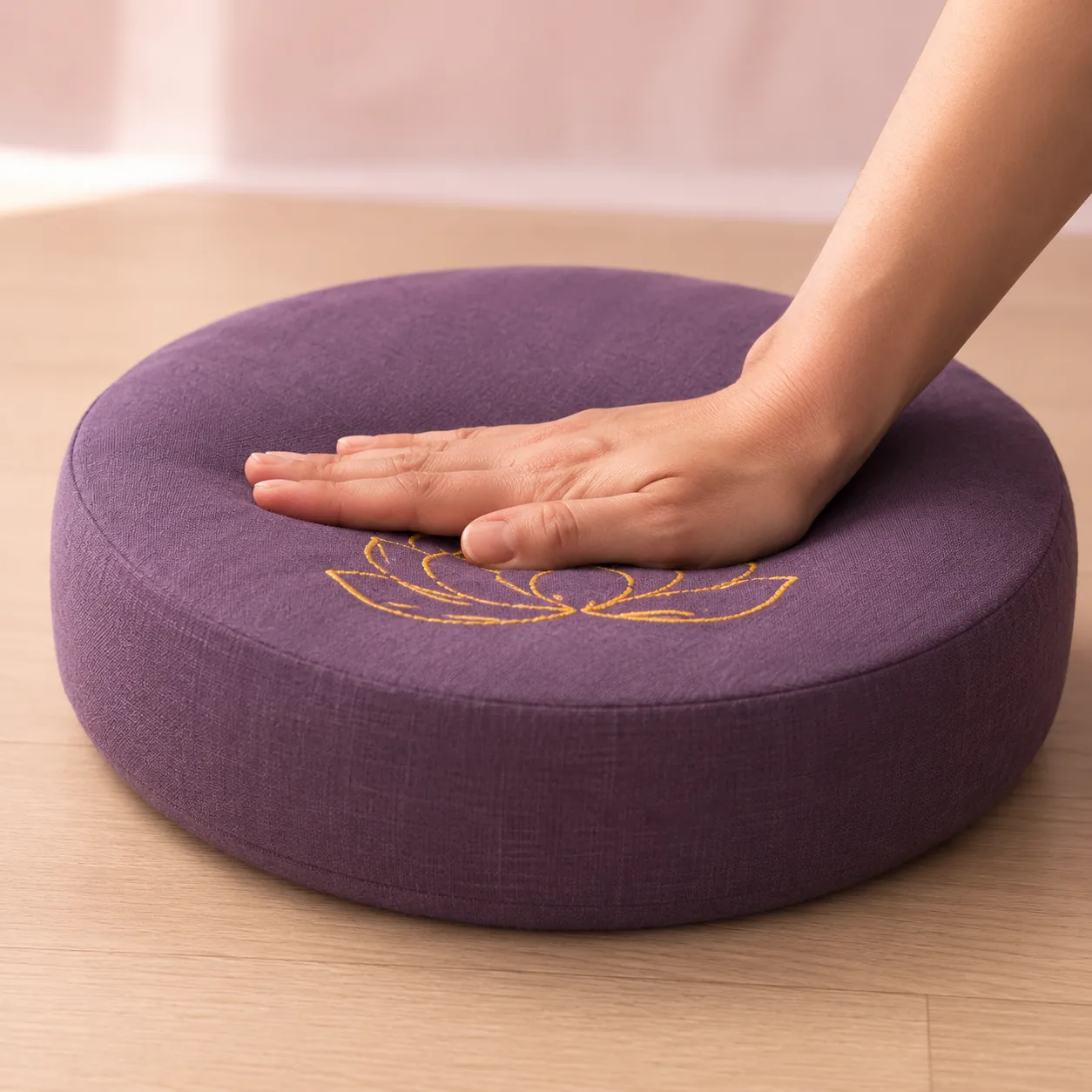
The measurement that matters is the gap between the height you sat down on and the height you are on when the session ends, because that gap opens under your pelvis while you are busy not thinking about it.
| Under a seated adult | Buckwheat hulls | Kapok fiber | Solid firm foam |
|---|---|---|---|
| First contact | Flows, then locks into a mold of you | Gives and springs back | Meets you at full height |
| Height after a long sit | Largely held once settled | Lower than at minute one | Unchanged |
| Movement under you | Hulls migrate when you shift | None | None, the core is one block |
| Top surface | Granular, can read lumpy | Smooth and continuous | Flat and continuous |
| Height over months | Compacts, needs topping up | Mats down, needs fluffing | Same profile sit after sit |
Read the last row rather than the first. Day one is the row every listing is written to win; the last row is the one you live with, and on it both loose fills are seats you maintain.
of Americans say they meditate at least once a week, most of them at home rather than in a studio
— Pew Research Center, 2018
At home, with nobody resetting the seat between sessions, a fill that drifts drifts unchecked. Height is a number you set once and then stop watching, and it is the number our what size meditation cushion guide asks you to get right.
Adding and removing fill
This is the one place a loose fill does something a fixed core cannot, and buckwheat does it far better than kapok. Hulls pour: a cushion built with a zippered inner liner lets you tip a cupful into a jar and sit on a seat a step lower than it was five minutes ago. Do it twice more and you have tuned the height to your hips rather than to the manufacturer's guess, which is why fill quantity gets treated as a setting rather than a spec.
Kapok does not pour. It comes out as a tangled mass, and putting less back means pulling the batt apart and spreading what is left evenly. Take too much out and you get a thin patch under one sit bone rather than a lower seat.
That dial turns one way in practice: hulls that compacted inside the cushion are gone unless you replace them. And adjusting fill is only ever a way of setting height, which you can measure on your own floor in five minutes with a folded blanket and a tape. A seat that arrives at the right height needs no adjustment at all.
Weight and warmth: what a bag of fill costs to own
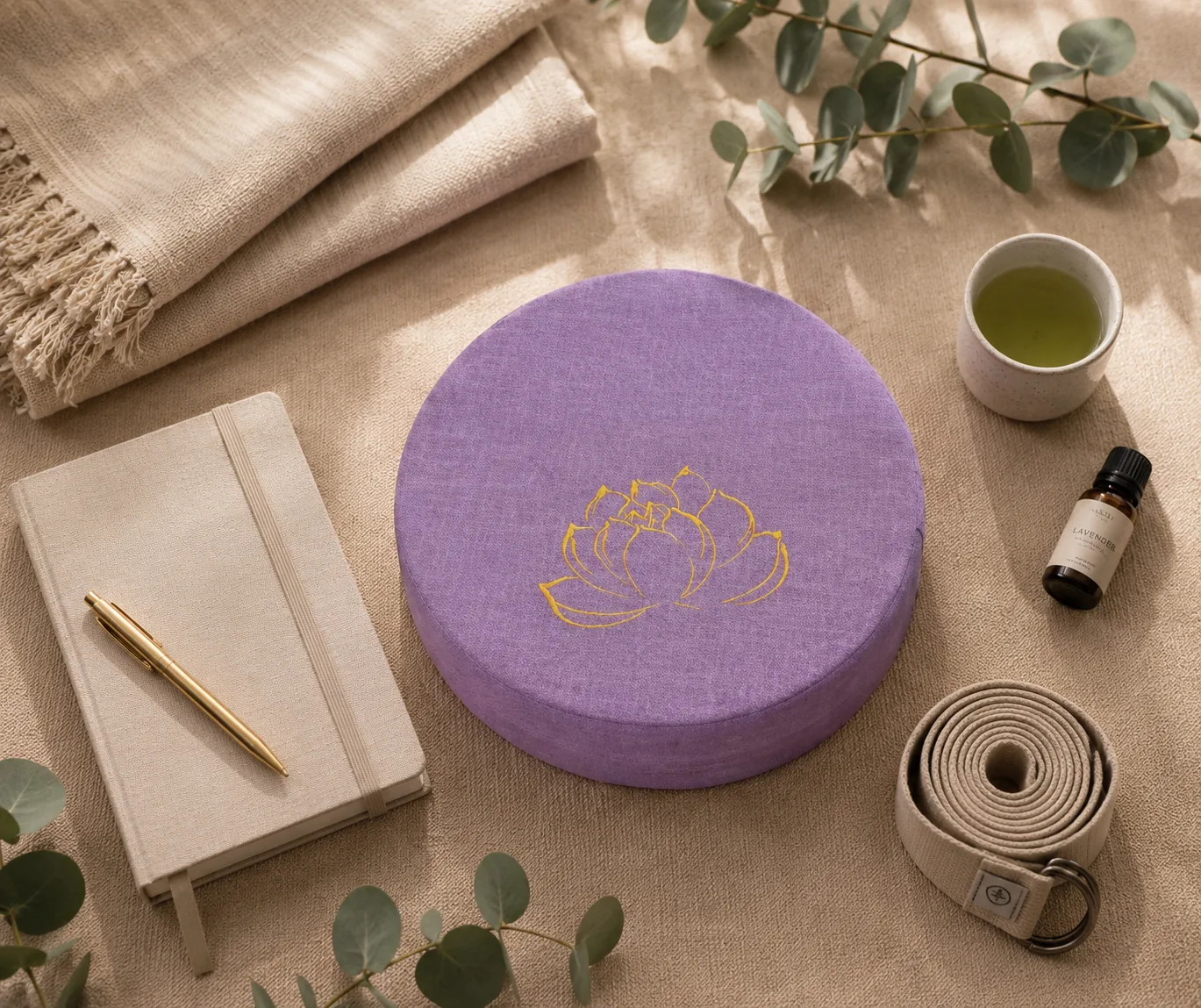
Weight follows from what each fill is made of. Grain husks are dense; fiber and trapped air are not. A kapok seat of the same size is the lighter object every time, and that decides whether the cushion moves around the house at all. A heavy seat lives where you first put it; a light one gets carried to the balcony. If your practice travels further, the formats that survive a suitcase are in our travel cushion guide.
Warmth works the other way round. Buckwheat is a bed of separate hard pieces with gaps between them, so air moves through the fill. Kapok is a dense tangle of fine fiber, which is the structure of an insulator: it holds warm air rather than letting it pass. In a cool room that is a comfort; through a long summer sit it is the fill that feels warmest under you.
Whatever is inside, the layer that decides how warm the seat feels against skin is the one you can change. A linen cover breathes, stays cool in a warm room and comes off for the wash: a bigger lever on comfort than the fill argument usually admits.
Buckwheat vs kapok care: washing, topping up, and how each fill ages
Neither loose fill goes in a washing machine. Hulls must not get wet, and a soaked kapok batt turns into a heavy clump that dries slowly. Care for both means a cover that comes off, and a fill you keep away from water for the life of the cushion.
They age differently. Buckwheat compacts: the hulls grind against each other every time you sit and shift, the volume drops, and the seat is quietly lower than it used to be. The fix is topping up with fresh hulls, which means keeping a supply in the cupboard. Kapok mats instead: the fiber tangles into denser clumps under load, so the loft goes flat and uneven, and the fix is to open the cushion and pull the fiber apart by hand.
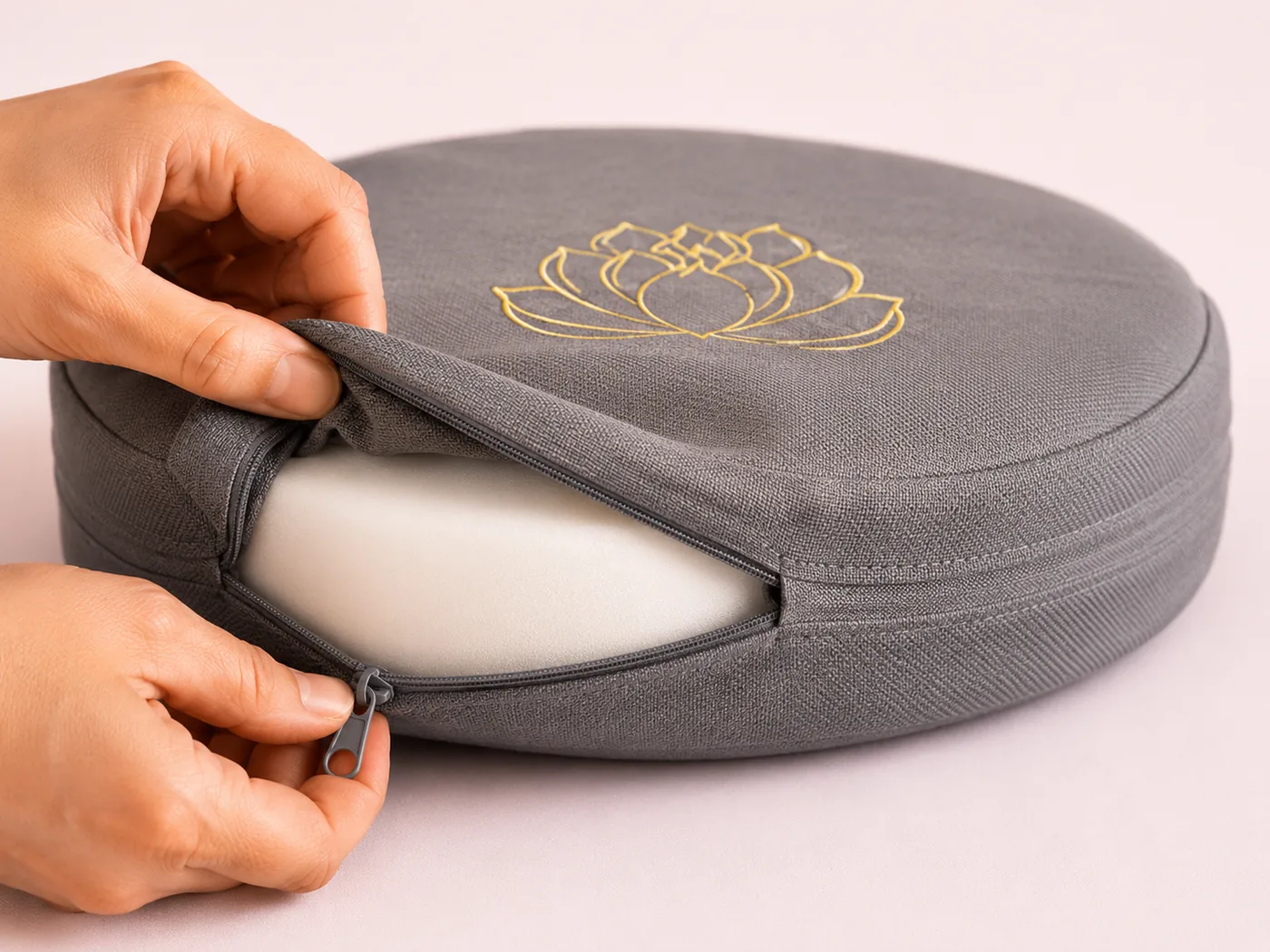
A solid core removes that chore rather than shrinking it. There are no loose pieces to keep dry: the core is one block that slides out of the zippered cover, the linen goes in the machine, and the part carrying your weight is unchanged when the cover comes back on.
Sound and smell in a quiet room
These get left off comparison tables because they sound trivial, and then turn out to be what you notice in a silent room at six in the morning.
Buckwheat is audible. A cushion full of loose husks rustles whenever the hulls move, which is every time you adjust a leg or lean a few degrees. Our type-by-type guide records it in one line: buckwheat holds height well but shifts audibly as you move. Kapok is close to silent, because nothing inside it slides against anything else.
Smell runs the same way. Hulls are a dried plant husk and carry the faint dry-grain scent of the crop they came from, strongest on a new cushion in a warm room. Kapok is a washed seed floss with very little smell of its own. Neither is unpleasant, but a granular plant fill is a fill with a smell and a sound, and a still practice is where you find out.
of U.S. adults practiced meditation in 2022, making it the most used complementary health approach in the national survey
— NIH/NCCIH analysis of the National Health Interview Survey, published in JAMA, 2024
Buckwheat vs kapok: which fill behavior matches the way you sit
The choice is not firm against soft. It is granular against fibrous, and each commits you to a maintenance habit for as long as you own the cushion. Buckwheat suits a sitter who wants a mold of their own underside and a height they can dial, and who will top the hulls up and carry the extra weight. Kapok suits a sitter who wants a light, quiet, springy seat and will fluff the fiber back into shape when the loft goes.
There is a third answer, and it is the one we sell, because both of those lists are maintenance schedules attached to a seat height. A single block of high-density foam removes the category: nothing pours, nothing mats, nothing needs topping up, and the height is the same on the first morning and the four hundredth.
In numbers: the StillSeat meditation cushion is a single block of high-density firm foam in a zip-off linen cover, 40 cm / 15.7 in across and 6 cm / 2.36 in thick. No loose fill, so nothing shifts, leaks or needs topping up. A verified buyer put it in two words on our reviews page: "Closed cushion and pleasant fabric."
Run the height measurement first, whichever way you go. The pelvis mechanics are in how to sit on a meditation cushion, and the way a lifting seat pairs with a padded mat is in zafu vs zabuton.
Buckwheat vs kapok filling FAQ
What is the difference between buckwheat and kapok cushion filling?
Buckwheat filling is loose grain husks: a granular material that flows around your sit bones, then locks into a firm shape. Kapok is a light seed fiber that behaves like a fluffy batt, compressing under load and pushing back springily. One packs, the other squashes.
Which filling holds its seat height longer through a session?
Buckwheat, by a clear margin. Hulls interlock and stop moving once settled, so the height at minute five is close to the height at minute forty. Kapok keeps giving under a static load, so the seat is lower by the end.
Can you add or remove kapok the way you can with buckwheat hulls?
Not in the same way. Hulls pour, so a zippered inner liner lets you scoop out a handful and take the seat down a step. Kapok is a tangled mass that has to be pulled apart and spread by hand, and the loft you recover depends on how well you fluff it.
What is inside the StillSeat meditation cushion?
A single block of high-density firm foam, not a loose fill. Nothing pours, tops up or needs re-levelling, so it keeps the same shape and the same 6 cm / 2.36 in height sit after sit. The core slides out of the zippered linen cover for washing.
Free shipping · 30-day returns